
Can Your Overseas App Really Succeed in Japan? GTM Strategy for a Single App with Japanese Support
Dec 19, 2025

One day, a customer from an app development company reached out to me.
"We want to launch this app in Japan. Can you help us with translation?"
Sure, the Japanese market is attractive for apps. But before you even think about translation, there’s an important point to understand.
Bringing your app to Japan as-is does not guarantee success. In Japan, the most critical factors for app marketing—App Store Optimization (ASO), UI, and landing pages—are absolute musts.
Key Premise: What Happens When You Launch a Single App with Japanese Support
Both the App Store and Google Play automatically detect the user’s device language. If a device is set to Japanese, your app’s UI, description, and screenshots will automatically appear in Japanese. Users can switch languages if the app provides that option.
Store pages can also be optimized per language. By localizing your title, description, keywords, and screenshots for the Japanese market, you can present your app in a way that resonates with local users. Reviews and rankings are separated by country, so you can accurately track feedback from Japanese users.
But simply creating a Japanese version isn’t enough. Without proper ASO, UI, and landing page optimization, your app will struggle to succeed. In Japan, adapting your app’s UI/UX, ASO (optimizing your app store listing to rank higher and convert better), and landing pages to the local market is essential.
Why ASO, UI, and Landing Pages Matter More in Japan
Here are some key facts based on both data.
Japanese Users Expect a “Perfect Experience”
In the US or Europe, users often tolerate minor UI inconsistencies. In Japan, attention to detail is paramount—every button, word choice, and nuance is evaluated. Even a perfectly translated UI can feel off if it doesn’t align with local expectations.Discovery Rules Are Unique
Around 60% of Japanese users discover apps through in-store search rather than ads or social media. This makes Japanese ASO a direct driver of downloads and revenue.Short Attention Span at First Launch
Overseas users might take minutes or even days to form an opinion, but Japanese users often decide within 10–30 seconds. Mature rankings, reviews, and overall app culture make users highly sensitive to small inconsistencies.Top-Level Willingness to Pay and Engage
Japan consistently ranks among the top five mobile app markets by in-app spending. High disposable income and a culture of integrating apps into daily life make it crucial to design discovery and retention flows that lead to ongoing usage and purchases.Negative Reviews Strongly Influence Behaviour
Japanese users read reviews thoroughly, especially negative ones. Reviews impact rankings and click-through rates directly, so Japanese localization plus optimized UX is key to boosting revenue.
Success Stories: Japanese UI + Japanese ASO + Japanese Landing Page
Some overseas apps have succeeded in Japan, and the common factors are Japanese UI, Japanese ASO, and Japan-focused landing pages:
DramaBox (China, short video app)
Localized UI and ASO propelled it to top rankings in Japan, reaching tens of millions of active users. Cultural adaptation was the key to success.
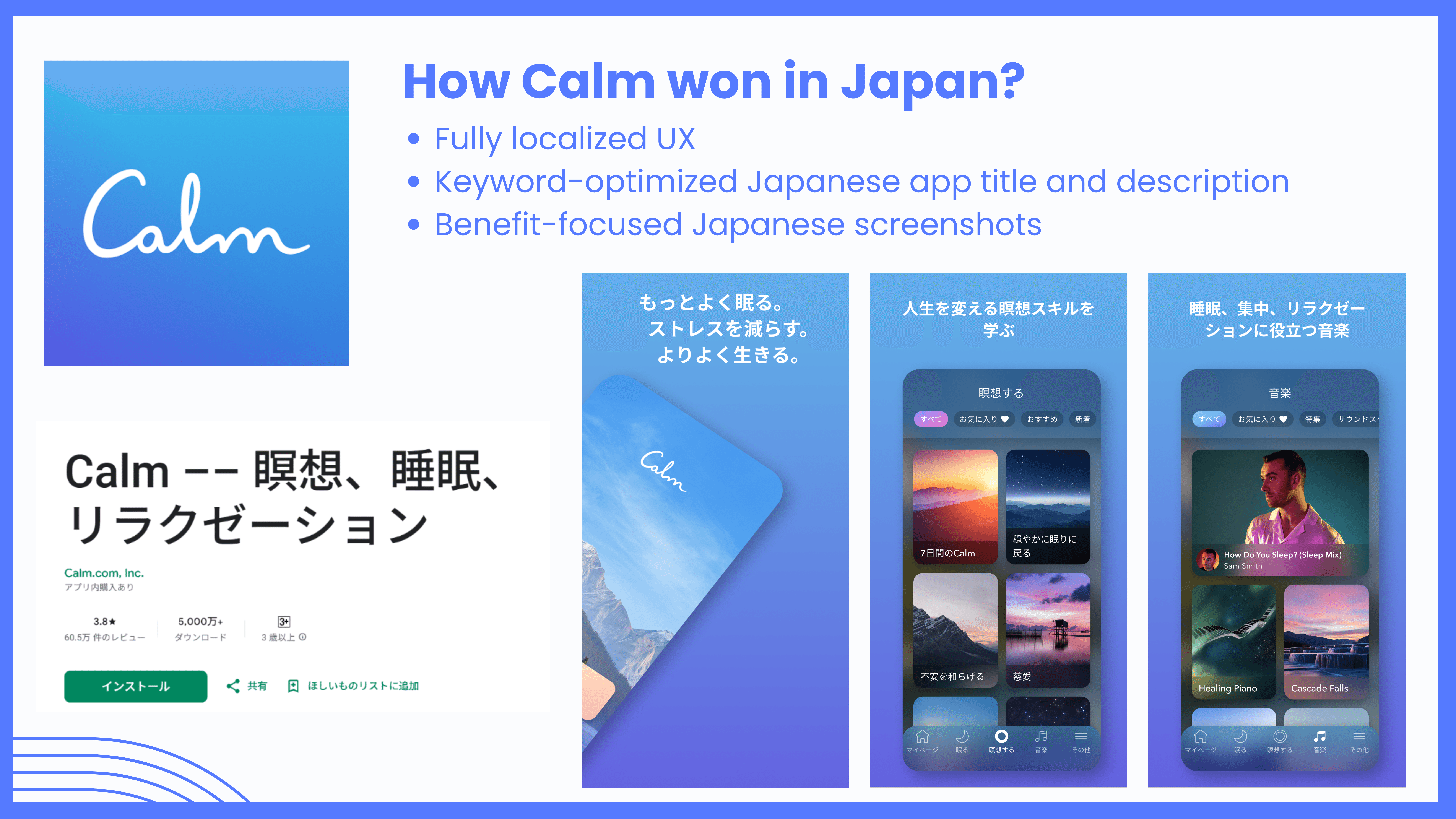
Calm (US, mental health app)
Japanese UI, ASO, and landing pages significantly increased downloads and in-app purchases while improving ad performance.
PicsArt (Global photo editing app)
Japanese tutorials and Japan-specific social campaigns leveraged local trends for viral growth.
How Tokage Works Supports B2C App GTM in Japan
We go beyond translation. Our strategy ensures users continue using your app, driving revenue through in-app purchases and ads:
Japanese UI/UX Optimization
Japanese ASO (App Store Optimization)
Japan-Focused Social Marketing
Optional services: Influencer campaigns, advertising and retargeting strategies, Japanese customer support setup, data analysis and improvement proposals etc.
Conclusion
Launching a single app with Japanese support is a good start, but local optimization of UI, ASO, and landing pages is essential.
Combining these with a GTM strategy is the key to driving downloads, retention, and in-app revenue. Translation alone is not enough—it must be fully optimized for the Japanese user experience.
Ready to See if Your App Can Succeed in Japan?
We offer a free diagnostic to evaluate your app’s potential in the Japanese market and provide guidance on next steps. Reach out for a consultation and start your Japan GTM journey today!